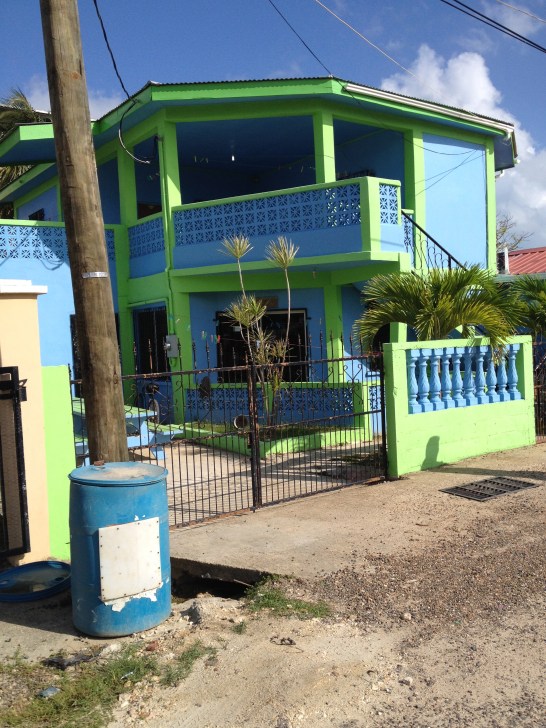
Home Improvement: Belize Edition


Monday morning, everyone was up and about early and for good reason. We were in a different country so many of us wanted to go out and explore around the neighborhood. After a wonderful breakfast prepared by Caroline, Starfish House’s caretaker, many individuals from our group walked down the street to the nearby beach. Along the way, we saw some of the local wildlife that inhabited the streets. They included large iguanas that were easily the size of cats back home and colonies of crabs that have dug condos for themselves in the ditches of the streets. You see, Belize sits below sea level, so the ground is shallow enough for crabs to dig for damp homes for themselves. This also means that Belize is prone to flooding during the rainy seasons so many of the houses here are placed on tall pillars to prevent constant house flooding. As much as we wanted to explore some more, we had a job to do and I did not want to waste a minute of the day.

IMG_0508IMG_0486

Our first step was to collect wood form the lumberyard and haul it to the worksite. Normally, our project worksites are many miles away in the most remote areas of Belize, but not this time. This week our workplace was only a block away from the Starfish House, which was very fortunate for us. This way we can spend more time doing things and less time traveling to the location.

The worksite was on the property of Ms. Price, a longtime supporter of Pappy and Janet Castillo, the family we were building the house for. Ms. Price had donated a portion of her land so Pappy and Janet can have a safe place to live. At the work site we met the remainder of our crew. Besides our group of 13, there was also Beto and Alfonzo from HHM, who coordinate builds like these, volunteers from the local community, Pappy and Janet of course, and future HHM house recipients.

To complete our task for the week, we had but one power tool at our disposal, a power saw. Aside from the electric saw to cut the wood we need, we had no other power tools for our project. That meant no nail guns, no paint sprayers, and no power drills. Assembling the house was to be done by hand with hand tools and no preassembled parts, a concept that was quite foreign to most Americans. Most of the people in my group were not accustomed to building anything bigger than a birdhouse or using hand tools, including myself. The people of HHM have been in charge of over 200 house building-projects all over Belize, and they have taught newcomers less experienced than us how to saw, hammer, and paint houses just like ours. As such, during the floor assembly, everyone got a chance to practice hammering nails and sawing planks to size.

When our first goal was met, it was time to head back to the Starfish House to relax after a hard day’s work. While walking back home, I couldn’t help but feel proud that I was part of a group responsible for building that floor with our own hands. We were all so happy and proud. Later that evening, we bought some drinks and snacks from a nearby corner store to celebrate our first victory in making a change to a family’s life. Some of us sat down to a game of cards to unwind. Some of us shared stories and sang songs to boost morale. I preferred to sit on a pier on the beach with my new friends to just to bathe in the cool ocean wind, soothing ocean waves and watch the sun sink into the distance.

IMG_0480

While we were partying, a man from the Building for Change (BFC) program, Mr. Panton, stopped by to thank us for participating in this endeavor and to explain exactly how the program works. The main guidelines for the program are as followed:

-BFC and HHM investigates applicants to see if they really need a new home

-Applicants must have some way to pay for the house in a ten-year period

-Applicants must show their dedication by volunteering themselves to build two other HHM houses and their own house

-Applicants that pass investigation are under contract with HHM

-Contract lasts for ten years. After ten years, the homeowners can do whatever they want to the house

-While under contract, applicants are not allowed to add or subtract to the house without HHM permission

-While under contract, applicants are not allowed to rent the home to others and cannot add more people without HHM permission

-HHM does not do maintenance to completed houses. HHM empowers homeowners by teaching them how to build a house

-If any rules have been violated by the homeowner who does not intend to desist, HHM may reclaim the house

Thankfully, there have been very few instances where it has become necessary to reclaim a house.

The next day started out a little differently than yesterday. This morning we took a trip to HHM’s other Belize project: Hand in Hand Ministries Outreach Center. It is a small resource center for children who have been diagnosed with HIV and AIDS. This place teaches the children what HIV/AIDS is and how to prevent it for future generations. The outreach center also provides medicine, food, showers, preschool education and a safe place for the kids to play. When we came to visit, the center was closed for summer break so we got to see what the center looks like in its down period. We didn’t see the children of the center until Wednesday when Resource people invited us for lunch.


After completing the tour of the resource center, we took a detour to visit to Frank Lizama, the wood artist. Mr. Lizama used to be the mayor of Belize City; now he spends his time crafting and selling religious wood masterpieces in his shop. Some of his works can be found in St. Martin Church. The hallmark of his creations is his famous Y Cross. A wooden crucifix made of beautiful Zericote wood with the Son of God stapled to a “Y” shaped cross instead of the traditionally “T” shaped one. The story behind this piece is that whenever Frank looks onto a crucifix he asks, “Jesus, why did you die for us?” The reply in his heart is, “Because I love you.”

We placed our orders for some of Mr. Lizama handiwork, and we were given a chance to take a quick look around his workshop to see what a woodcrafter’s work place looks like and what kind of tools he uses. After the tour, we hastily returned to the worksite to resume our work on the house-building project. With most of the day already burnt out, we had little time to waste if we wanted the home finished on time. Today our daily goal was to build the four main walls and then paint them using oil-based paint.

As soon as we arrived to the workplace, everyone raced to their tools and work stations. I was part of the sawdust team. Our task was to use the power saw to cut the wood parts for the build team to hammer together. The painters would then come in to paint the finished walls.

Though the idea was straightforward enough, my group had never built a house before so we didn’t know what to do after each task was done. As such we spent a majority of the time looking for Mr. Alfonzo to tell us what was next or look around and see what else needed to be done. Thankfully, with everyone’s cooperation, we were able to complete the walls on time. Soon after, we returned home to rest, go for a beer run, and prepare for the next day.

Belize

After touching down and stepping out of our cool, comfortable, air-conditioned plane, the first thing I noticed about Belize is that it is hot. It may have been early afternoon, and it already felt like was hot and humid enough to bake breakfast on a sidewalk. Inside of the airport was not much better. While here, in the United States, we are spoiled enough we keep the inside of our buildings warm or cool according to what we desire, the buildings in Belize only provided shade and shelter. No air-conditioning. Residents of Belize didn’t care about the heat because that’s all they have most of the year. Belize only has two seasons all year round: hot and rainy.

Our bus driver and program coordinator, James, gave our group a tour around Belize City before heading to our boarding house for the week. The moment we started out, I noticed immediate differences between our cities back home and the city here. While in the States, people try to live apart from each other as much as possible. In Belize, it seems like the entire city was stacked on top of each other. All the buildings were meshed together and the entire populace was out and about. The streets were full of vendors selling the fruits of their trade to any passerby. Some sold fresh fish; others, fruit, hot lunches, and other goods. James went on to explain that Belize’s nationality is a mixed population of Maya, European, Spanish, Middle East, Asian, and American. Because of the density of the population and scarceness of resources, the people really don’t care about racial superiority. Nobody in Belize can afford to be picky about their neighbors. They only care about living their lives and will take any help where they can find it. The only real crime in Belize is illegal drug trafficking. Even the customs regarding driving differed between the United States and Belize. The rules weren’t difficult to understand. The main rules were whoever has the biggest car has the right-of-way and pedestrians are to make like a frog in traffic and DODGE!

We stopped by the Starfish House to drop off our luggage. But before we got comfortable at Hand in Hand Ministries’ (HHM) Belizean home, we were taken to the sites of past HHM house-building projects to meet the families who now reside in them. This tour was to give us newcomers an idea what the houses actually look like inside and out and to see how the families best utilize their home. This was also an opportunity for us to meet the kind of people we were helping during our stay.

IMG_0610

After the second house visit, my consciousness began to steadily fade. Like a brick lunched from a second story window. My lack of sleep from the night before had finally caught up with me, and I felt like a dying phone battery. After we said our goodbyes to the families HHM has helped, we set off to the Starfish House, our home for the next seven days.

HHM uses the starfish emblem a lot during their line of work. They use the starfish as something as a mascot in a lot of their functions. The reasoning behind this is because HHM draws inspiration from “The Starfish Story.” The story goes like this:

One day a man was walking along the beach when he noticed a figure in the distance. As he got closer, he realized the figure was that of a child picking something up and gently throwing it into the ocean.

Approaching the child, he asked, “What are you doing?”

The youth replied, “Throwing starfish back into the ocean. The sun is up and the tide is going out. If I don’t throw them back, they’ll die.”

“Dear,” the man said, “don’t you realize there are miles and miles of beach and hundreds of starfish? You can’t make a difference!”

After listening politely, the child bent down, picked up another starfish, and threw it into the surf. Then, smiling at the man, he said, “I made a difference for that one”.

HHM uses this story as their symbol, philosophy, and inspiration towards all of their endeavors. A metaphor I tend to agree with. In the line of social work and even as an individual, one person can’t change the world alone, but one person is enough to change the lives around him.

It was about late afternoon when my group finally returned to the Starfish House and my eyelids couldn’t have been happier. As soon as we crossed the doorway of the Starfish House, everyone soon drowsily migrated to their assigned beds and took a much-need nap before finishing dinner and a lovely mass at the open-air St. Martin’s Catholic Church.

Beware of Trolls That Dwell in Cardboard Castles

The week before my trip, I had a conflict with a coworker. Not my fault! This individual typically works in my warehouse’s box-making area…and nothing else. Box making isn’t a difficult task. The chore involves taking flat boxes from a pallet, load them into a folding machine, take folded shipping boxes from the machine, and loading them onto a motorized overhead conveyor to be distributed to the warehouse packers. A dismal task to say the least. If it wasn’t boring, then it was annoying, as the machine would always break down if you so much as look at it.

My coworker, however, took great pride in this task. So much so, he believed he the manager of box making. He was no manager. This pride has rewarded him with a nasty temper and would often snap at anyone who wouldn’t do things his way or who denied him his favorite job. Even before our confrontation, I didn’t agree with what he did, how he treats others, or his lack of spirit in life despite being only in his mid-thirties.

If he wasn’t belittling someone for bring him the wrong colored pallet-jack, he was inventing new rules that the real managers didn’t authorize, saying that certain people don’t deserve to work there, loath the company picnic at an amusement park, and made his coworker’s jobs harder than it needed to be. And now it was my turn to work with him.

I was going about my business. I had my box-folding machine, and he had his on the opposite side of the area. I loaded my boxes on to the trolley, saying nothing, and he did the same. As I was working, I felt some kind of tension in the air, the same kind of aura you would feel from an angry parent, but my thoughts were too occupied elsewhere to care. My head was dancing with excitement for the prospect of going to Belize and imaging what wondrous adventures I may have. I couldn’t care less about the other guy or what his problem was. For three hours, we said nothing to each other ––– not even a “hello.”

I was about to load a stack of finished boxes onto the trolley. Then – Boom! – I was shoved out of the way by the supposed Box Master. Instead of an apology, he went on a rant that I wasn’t doing my job properly and that his boxes were more important than mine. I was stunned, but only for a moment. My mind briefly flashed back to the soulless English teacher that bullied me in college. I then felt a grenade pin drop in my mind. The anger I have suppressed from that time combined with the frustration of my unfulfilled life came out all at once.

My retort was loud and came complete with colorful names and signing a very insulting salute. My reply made the coworker-turned-box troll angrier and started proclaiming that I was an evil person. Making insulting accusations that loosely translate to “nobody likes me,” “I intentionally annoy others,” and “I was alone and soulless.” I saw that this conflict could only end badly as he knocked over a stack of boxes during his hissy fit. So instead of risking my job over the Box Troll, I packed up my things, left to report to the managers, and left more kindly words as a rebuttal as I left.

I wasn’t terribly injured, but I have already lost a battle with one adult bully; I was not going to be a victim to another. Not without sharing my honest opinion of him. Even if he was signing my checks, he had no excuse to treat me like an underling. And besides, of all the problems in the world, he chose to pick a fight over boxes…how lame is that?

When I relayed my story to my manager, she was not surprised to hear that the Box Troll has scared off another partner. I was not the first to be chewed out by the Box Master over his supposed supremacy in his domain. It was no secret to anyone that he loathed anything but cardboard construction and demanded respect for his “skills.”

After I was reassigned to a new job and had time to cool my head, I began to reflect on what happened back there. I had only worked with him a few times and I knew very little about what he does outside the warehouse, or if he even has a life outside his job. I was certain he knew as much about me as I did of him. So how could he have possibly become so convinced that I was an evil person when all he knew about me was that I was a piss-poor box maker? How could he say such cruel things about me when our dialog between each other has been shorter than the attention span of a goldfish?

From my training as a social worker, I analyzed what I knew of this man to make some kind of sense of this his obsession for paper containers. After some hours of pondering, the only reason that made any sense to me is that he wanted control like most bullies. From my prior interaction with this guy, I gathered that he may lack control over his life at home and the reason he enjoys box-making so much is to take back some of the power he lacks from home through his coworkers. And now he hates me because I question his authority, I debate his methods, I didn’t show him the respect I would show a manager, and I didn’t give him control over me.

As sad as all of this may seem, I don’t have any pity for him. I’m not a professional social worker yet, he wasn’t my client, and he doesn’t want my help. The Box Troll may keep his precious Cardboard Kingdom. He can shout and play with his imaginary power all he wants, but I know for a fact that I am still better than him. I don’t need to step on others to feel good about myself. I don’t need to bully others to have control over my life. I have a lifetime’s worth of astonishing achievements under my belt with no intention of slowing down. Now I’m journey-bound to Belize to build a home made of wood, dreams, and hope.

I’m Ready to Go

Beep, beep, beep goes my alarm. As usual doing its daily duty to interrupt my dreams and remind me of my own daily tasks that can’t wait after nine in the morning. But today I needed to wake early, very early. Too early for work, school, or Christmas, although I was just as excited for the occasion. Today was special, for it was the day to make a difference to my life and many others. At 6 o’clock in the morning in the summer of 2014, I left for my immersion trip to Belize in Central America.

The concept of me traveling to another country has been a fond fantasy of mine. Whether it was for business or pleasure, I wanted to see the world in its true colors. On TV, we often hear the best features of a far-off place to attract tourists, and we hear the worst of another to fester panic for a news broadcast. I wanted to go to these places and see these places in their true light. I want to see the world through an unfiltered lens.

I have made attempts to follow this desire many times in the past. My first was in college and I applied to the school’s Study Abroad Program. Unfortunately, I didn’t have enough money to take me through that route. After college I tried again through the Peace Corps. With a social work degree and a sizable volunteer background, I thought I was a shoe-in to travel AND inflict some good in the world. Alas, it was not to be. The national level recruiters thought that I didn’t have the social competence to handle changing circumstance on the job, and so that bridge fell through along with a good portion of my hopes for the future.

Out of desperation, I entertained the idea of joining the Navy. I had no illusion of being the next American super soldier, but given the vocation of the men and women who are on board these ships, they would surely need a psychologist for professional counseling on board while traveling from one port to another. I went to their recruitment office to ask if they had room for a social worker. Only to found out that it didn’t matter. The Navy hiring policy prevented anyone with autism to join under any circumstances. As you might imagine, I was understandably sore to be denied due to something that wasn’t my fault. And so I was stuck in Kentucky and forced to continue working at a job that exercises none of my talents and satisfies none of my desires.

During an average day at work, I was in the middle of my usual routine when a thought hit me, “Hand in Hand Ministries does mission trips right?” With that one question, more sprang up. What is involved in these trips? How much does it cost? What skills are needed? What good can I accomplish? Soon questions became curiosity. Curiosity became ambition. And ambition became a plan.

At once, I shot Hand in Hand Ministries an e-mail asking them about their mission-trip programs.

Ever since my Eagle Project during high school, I have been a frequent volunteer for Hand in Hand Ministries (HHM). Their needs were often domestic, such as unloading a truck of incoming donations, loading outgoing donations to needy communities, and preparing HHM’s newsletter. However, HHM’s yearly hallmark of accomplishments is in their immersion trips to Appalachia, Nicaragua, and Belize. Every year HHM would gather a group of volunteers to venture to these locations, spend several days with the local community, take some time to see the world as they do, and leave behind a change for the people there. Although I knew about of these programs, I was focusing my efforts in joining a Peace Corps-type program and never investigated what was involved in HHM’s overseas programs.

I looked over HHM immersion brochures and became attracted to their Building for Change program in Belize. The trip involved taking a group of about 13 volunteers to Belize City and building a 16-foot-by-16-foot house for a family in one week.

At first the idea sounded preposterous. A group of 13 with no home-building experience is going to build a house in just seven days? However, the manager of the program assured me that:

1) It is not only going to be the 13 of us. We will have additional help from other families and volunteers with homebuilding experience

2) HHM has built over 250 houses just like this all over Belize and has always managed to finish the job in three-to four-day span

3) A 16-by-16-foot house is about the size of a small garage. Plus, our task will not include installing electricity, running water, or outgoing plumbing.

With my doubts quelled I immediately made arrangements to follow this quest.

To make arrangements easier I booked my place on the trip months in advance giving me plenty of time to prepare. Getting the time off work was not a problem. After a year of box shunting, I was due for a trip anyways and was able to request a full week of vacation time off. The trip was expensive, too, but I have been saving my hard-earned money for just such occasion. Getting the supplies was no problem, either; HHM provided me a supply list and a schedule so I would know exactly what was supposed to happen and what I would need for that time. Naturally, my parents would be worried for my safety overseas, but they were proud to see me go out into the world and do some good like they had in their youth. With preparations set, I was ready to go and fulfill my ambitions at last.

Outrunning Boredom

The Real World can suck at times. Being stuck in a warehouse 10 hours a day can wear on a person’s morale very quickly. In my spare time, I experiment with different hobbies to cure myself of boredom and remind myself that I’m person, not just a cog in a machine. Even in the time, I didn’t feel like doing anything constructive, I felt compelled to do something. I felt like I always needed to do something to occupy my time.

During college, one of the ways I spent my time off was by raising a small tank of fish. The fish gave me some healthy responsibility and company as I was going through my freshman year. Later when I moved to my second dorm in the second year my mom dared me to try my hand at raising plants in my dorm as well. Although my new dorm room was the size of a broom closet, it had access to a lot of natural sunlight. The plants became another good distraction for me. It was rewarding to see my plants mature and develop right before my eyes.

After college, it took me a long while before I could finally land a job. In the meantime, my Mom dared me into another hobby. While I was away at WKU, my family got invested in running. My mom, dad sisters, and several of our close friends were in on it. So it was only a matter of time before I became absorbed in it as well. After some coaching and proper gear, I came to enjoy the sport as a way to being healthier and a way to connect with others.

The unique thing, I feel, about running is that you run as an individual, yet you are also part of a community event and connect with fellow runners to encourage to do our best. I got this feeling while I was running in a thirteen-mile marathon through the city of Louisville.

Early Saturday morning, I was running and making good progress. Out of the thousands of runners that surrounded me, I had no idea who was in front of me or behind. My head was in its usual trance while I pace, listening my favorite songs on my phone. My head was so far in the clouds that I didn’t notice the road construction around the 5-mile marker.

I tripped on a piece of loose concrete from the construction in the area and I went down, hard. And there I was, on the ground with two scraped knees. Before the first drop of blood could leave my knees, several of the runners behind me stopped dead in their tracks to help me up and ask if I was OK. After I was to my feet and dusted down, I assured everyone that saw my fall that I was OK. The wounds to the knees didn’t make resuming the race easy.

At first I could only limp along, nursing my new handicaps. The thought of quitting right then and there had cross my mind. But something urged me to keep going. Maybe it was my own determination to finish what I have started? Maybe it was the synergy of competition that surrounded me that forced me to go on? Maybe it was both? Whatever the case, it worked and eventually I was able to bring myself back up to steam and finish the race in two hours and fifteen minutes!

When I race, I run for myself and my own reasons. Your goals are your own. Your strength is your own. Your ambition is your own. And the only time you fail is when you decide that it was not good enough. It is a perfect sport in which anyone can participate, nobody can feel alone, and feel awesome that you have accomplished something worthwhile.

IMG_0463

Here are some of the metals I have collected over the years while running.

Working From the Bottom

With diploma in hand and résumé drafted, I was ready to jump into the social-work field and put my new education into practice. In the spring of 2012, I started out by applying to several jobs at a government social-services organization. I had just got out of school, and I was in no hurry to have a job yet. After a few online applications, I kicked back, relaxed, and waited to see where my life was going. About a week later, I get an email saying that my candidacy was rejected. “No big deal”, I thought. Maybe they weren’t interested in me right now. I quickly moved on. However the more places I applied, the more skeptical I became.

About a year goes by, and I was still not in the social service industry and still jobless. I wasn’t being a snob about my search. I tried out many different agencies to at least get my foot into the door. Government, private, non-profit, internships, special needs, homecare, daycare, animal shelters. They all wrote back the same thing, “We thank you for you interest, but we have narrowed our candidacy to other applicants.” Each time I find this dismal message in my mailbox, it solidifies the notion that either I doing something wrong, or something else is afoot.

To prepare myself in this new level of social interaction, I applied to résumé workshops, interview practice, and speech therapy. I learned a lot from these classes on what it means to talk with others in a professional manner. Now armed with new manners, I tried my luck again and applied to a slue of jobs that claimed that they were in desperate need of social workers. However, despite my best efforts I still found rejection letters in my mailbox day after day.

It then occurred to me that these social work agencies were like an exclusive club to get in to. They didn’t want just anyone with a diploma to work for company. To be considered for an interview you need to know someone that already works at the company you are applying to, pass the leisure exam, know the secret handshake, and have 5 years of on-the-job experience. Job experience that I don’t have, and nobody would let me have or provide me a chance to prove myself. I also couldn’t take the license-giving exam because I wasn’t part of a social work company. My life was in a classic Catch 22.

It wouldn’t be years later that I would find out my school didn’t have any direct ties to the state government. Meaning, schools that DID have ties to the state would be given preferential treatment and given first dibs on any social work jobs. Meanwhile, graduates without those connections were on our own and had to figure how to get a job under our own power and I have already experienced how well that goes.

I was in a bind: Student loans were piling up, I was running out of money in the bank, and the Bank of Mom & Dad was closed. I lived in an expensive society and I needed money regardless of my professional goal or my education level.

So, with much bitterness, I applied for a job at a warehouse. Where you get paid minimum wage to shunt stacks of cardboard boxes from one end of an oven-tempered building to another. At first, I did some odd jobs for different companies through a temp agency. Some required that I take a surprise math quiz as part of the application process without a calculator. One place I applied was a tech company that was waiting on parts, and I’m still waiting on their call. Others were warehouses that collected parts for cell phone orders, unloading packages from trucks, etc. Although different in their merchandise specialty, I barely saw any difference between them. They had a complicated work process that didn’t work, the managers ignore the problems, and I had many coworkers that were not friendly. After a half-a-year of bouncing from one warehouse to another, I finally landed a long-term gig in a warehouse that specialized in shoes, among other things.

It was supposed to be just another hot, dust-filled building, and it was. But unlike the other warehouse jobs I had, here the work was simple, the coworkers were friendly, and the managers were proactive. During rest periods, there were times I would have casual conversations with my coworkers. As time went by, I eventually became one of the company trainers for the new warehouse associates.

Was this warehouse my true calling on life? Do I plan to stay here for the rest of my life?

No.

If anything, this detour only fueled my ambitions more. Warehouse work was easy and put money in my pocket, but I needed to move out and experience more. I was not as ambitious like Bill Gates or Steve Jobs. But I was restless enough to be dissatisfied with my life’s current state of affairs.

For the coming years, I spent the majority of my free time running marathons, involved with Boy Scouts as an adult leader, and working to build up a nest egg for myself. I didn’t know yet what I was saving for, but I lived in an expensive society and whatever I planned to do with my life was going to require money and lots of it.

Graduation Again

I woke up one early on a chilly Thursday morning in December 2011 and went about my usual morning routines. The day should have been like any other, but it wasn’t. For this particular Thursday was my last day of finals. My body was tense with anticipation. My brain was doing everything to retain every detail of my studies. My mind was geared towards facing my final obstacle that lay in wait for me and what it would mean if/when I passed.

The tension that surrounded me was (please excuse the cliché) so thick you could have cut it with a knife. I had faced final exams before and they were no picnic, but this was the test that could decide whether I graduate or not which made the stakes all the higher.

After about an hour or so, I put down my pencil for the last time at WKU and I handed over my exam to the professor. It was over. I was done. I was finished with college!

As I was walking back to my dorm, I felt so weightless. No more tests to worry about. No more project papers to contemplate or complete. I had nothing school-related to fret over. I could not keep this Cheshire cat-like grin from my face knowing full well that another chapter in my life had been completed in the best possible way.

Now came the most exciting time of all. Although I wouldn’t know all of my final scores until many weeks later, I was at my proudest moment, the graduation ceremony. I hadn’t felt this level of joy and self-accomplishment since my Eagle Ceremony or my high school graduation. My fellow social work colleagues and I couldn’t contain our joy as we walked up together to receive our hard-earned diplomas with our families and friends’ looking on.

Although the diploma itself was just a fancy sheet of paper, we give it meaning through our actions and our accomplishments. Then when our diploma is finally handed to us, it forever baptizes our commitment to our futures. However, despite all the cheers, applause of congratulations, and the party afterwards, I knew in my heart that my real journey had yet to start. Graduation was only the beginning.

Unfortunately, this new beginning started out with paying student loans. You see, despite my accomplishments at WKU and throughout my life, I was still burdened with debt to pay and no scholarships to help. During the course of my college term, my family and I had looked for grants to help ease my financial burden, but to no avail. Plenty of money has been used to research autism but not one dime of it goes to supporting an autistic student through college. While at the same time students with other disabling factors (low-income backgrounds, physical disabilities, etc.) can receive grants that can carry them all the way through college. Unfair but true, and I hope it changes soon.

The END is Coming

My final semester at Western Kentucky University—this year marked the final chapter for a very important time of my educational career. As I was going about my usual routines in the semester, I grew more and more restless with each passing day with the realization that the end was coming. All my life, I had only known life as a student. The largest majority of my life had been centered on studying for tests, completing book assignments, and gathering data to compose a project. Now, all my effort and patience was going to pay off, and my life as a student was coming to an end. As my days as a student were drawing shorter, I couldn’t help but count down the number of weeks, days, and hours that stood in the way between me and the real world.

Then something happened to make my graduation even more memorable! Midway through the semester, KAP was hosting their annual support-appreciation banquet. An event to honor all financial benefactors and moral supporters that have allowed KAP to grow over the years. Weeks before the event, KAP asked me to take part in this event by saying a few short words of thanks to WKU and the reigning president on video. The reason they choose me was because I was the only student at KAP who was scheduled to graduate that year.

Something unexpected happened. During the banquet my thank-you video wouldn’t play. In resolution, KAP’s director asked me if I would be willing to provide a live performance. I didn’t have a script handy, I was wearing a dirty jacket and blue jeans, my hair was a mess, and I hadn’t even shaved for the event. I had every reason to say “no”, but I went up anyway. Armed with nothing but my wits, this is what I said:

What I was trying to say… *pauses for laughter* is that I want to say thanks. It is difficult for someone like me to find the educational support that I need to grow to my full potential. Thank you for allowing me the opportunity to explore, try new things, and make mistakes when I need to. Again, thank you.

It may not have been the Gettysburg Address, but the audience enjoyed my live performance, rather than the recorded one. The biggest highlight of that evening was that after my speech, I was able to shake hands with the president of WKU, and I received a standing ovation.

I suppose this is one example when something better comes out when they don’t go according to plan. Knowing how to improvise has its merits too.

More Than a Career?

“As a social worker, how can you make a difference?” This was the question asked during the first social work class. Off the cuff, this was what I wrote in response:

The reason I believe that I can make a difference is because ever since I was young, I’ve never been the type to stand by and do nothing. The one thing I truly hate is to be the one who is “dead weight” to a circumstance. I have a perfectly healthy body, I have a mind in my head, and a heart in my chest. So there is no reason I can’t make a difference to someone’s life.

Even now I still stand by what I said. There are only two conditions that would prove me different: the lack of know-how to make the needed difference and if I had the opportunity to make a difference happen.

The first couple of Social Work classes covered the basics of how to act like a professional. Such as how to get a job done, what values a worker must adopt, and how to behave under certain circumstances. Out of any of these key points, I thought the knowledge of how to act interact with a client was the most important to me. The proper order of things had always been a mystery to me. Including how to talk to people.

In this field, it was impossible to avoid people. If I wanted to help people, I had to play by their rules. And now I had the opportunity to learn those rules. In my future classes I had begun to learn the proper etiquette of how a social worker professionally consults with a client. This etiquette includes how to be an active listener, how to interpret non-verbal signs, how to know what kind of questions to ask, how to phrase the questions, how to structure a conversation, how to take note of every essential detail, how to be thorough with the information you receive from the client, and much more. Of course KAP, was there to help hone my skills.

Seeing that KAP is also a social service agency, they were able to provide useful advice on what to do for my interview projects and how to improve my interview performance.

Of course this form of vocal exercise took more than just one class session. My professor knew of my autism and knew that I would require some extra help and so thought that it would be wise if I had some extra training outside of class. I thought the idea of extra training was wise as well.

For the extra interviewing practice, my professor referred me to another social service agency stationed on campus. The Family Resource Program (FRP). The Family Resource Program is an agency that specializes in interviewing clients, access what the client needs, and then refer the client to additional resources that can satisfy the client’s needs. Given the nature of their work, the workers there were the ideal tutors to help me overcome my vocal limitations.

I returned to the FRP in my free time and utilized their training for the remainder of the semester. This training consisted of being engaged in several different mock-interviewing scenarios. In the practice scenarios, I would play the role of the social worker and a staff member would impersonate a client who had come to seek my advice. During these demo interviews, an observer would provide active constructive criticism if I perform inappropriately. During the course of the next couple of months, I learned how to structure my conversations and how to handle unusual client situations.

During my practice lessons, I also began to figure out my own preferred strategies and my flaws in my interviewing techniques. One of my faults as a social work practitioner is that I had a habit of projecting myself on to my client. That is to say, I would use myself as a base model and urge my imaginary client to behave as I would. Ethically, such a practice is a taboo in this field.

During these classes, I had also begun to rediscover my own voice. Now that I was better informed to what is polite, I felt a little more comfortable talking to people.

In a Social Work Practice class, the professor asked each student to host a short activity before the start of each class. The only requirement for the nature of the activity was to demonstrate a key aspect of Social Work ethics. For my activity, I requested the class to take out a blank sheet of paper, draw a big circle on the page and then draw an emblem that represented their own character and personality within the circle.

The idea behind my exercise is that before any social worker can be allowed to help a client and/or intervene in a client’s affairs, the social worker must first be in tune with their own selves. I felt that it was essential that each worker must know the limits of his or her own strengths, weaknesses, emotional limitations, moral tolerances, and essentially have their own inner political affairs in order before delving into a client’s case. I thought that the best way to demonstrate this concept would be to translate your character into a simple caricature.

Following my own advice, my exercise had me looking at myself in a different way. Up till this point, I had kept a small memo book’s worth of guidelines of what I thought my personality was like in the back of my head. But new questions came to me: How well do I really know myself and will it be enough to fill a book? Would that book be an interesting read? Would my story inspire others? I knew what kind of person I fancied myself as, but how much of it was reality and how much was fantasy? I feel that such self-reflections are necessary if one wants to grow into a better person.

Along with my social work classes for my major, I also took a variety of other classes that I felt would be an added benefit to my degree. I had already completed my requirements for my Gen Ed, so the nature of these courses could be anything useful, useless, and/or fun. So, I choose to expand my knowledge in the fields of sociology and psychology.

I took a class in Developmental Psychology. As a social worker I would not only be working with people from different nationalities, but also different ages. I thought that knowing how people cognitively mature as a species would further aid how I could help my future clients. I thought that this class would also, in turn, expand my understanding of a person’s illogical social behavior.

I also chose Psychology of Personality to learn about a person’s intellectual structure from birth to old age. I had known beforehand that a person’s personality is shaped by their past experiences, good and bad. How we translate those experiences is how we become the person we are. I took this class to see what other kinds of external factors shapes a person’s cognitive development, how to analyze the mind during different stages of maturity, and to see what kind of structural techniques shape a person’s persona.

At first I signed up for Supernatural Folklore just for fun and only for fun. However, I soon discovered that the content of folklore had more sociological applications than I would have normally thought. The realm of folklore consists of elements of varying cultural traditions, religion, superstitions, and spiritual attunements. The tests were horrible, but the content was enlightening and fascinating. I was finally getting answers to my dormant questions I had regarding what kind of elements motivate and influence different groups of people. These folklore elements have ties to sociological factors, which could influence certain social behaviors. One’s beliefs, be it religious and/or supernatural, can influence their attitudes and help shape their personality.

Similarly, while I was taking the Sociology of Gender class, I wanted to see how far gender was wired into our society and how one’s gender influences a person’s decision making processes and philosophies. I was surprised to see how much gender played an active role in human societies across the world.

Developmental expectations, professions, attire, hobbies, family traditions, deities-these are all gender ordinated in one manner or another. Thanks to this class, I can’t even watch TV without doing a gender analysis.

While taking these classes satisfies the requirements for my major, it also helped me to further expand my social repertoire and has taught me how to be more vocally active, how to be more responsive, and more importantly, how to act like a person.

Tools of the Trade

Autism has become a lot more marketable since I was a kid. When I was in the 4th grade, I didn’t have access to many autism specific tools. I didn’t see anything autistic themed on TV, new paper, or stores. Now? I can find catalogs the size of phonebooks with autism specific tools and toys. Aromatherapy diffusors, special seats, noise cancelling headphones, chewable necklaces, indoor hammocks are to name a few that are available now. There are research fund raisers for autism, therapy groups, and support centers like the Kelly Autism Program. Even Sesame Street has a new neighbor who is on the spectrum. The mark of the puzzle piece has made its way to the surface of society. Of course with great popularity, also comes the need of great caution to separate fact from fiction.

When the results were in that I had autism, my parents did a lot of research on autism. Some was helpful, some…not so much. They had to dig deep to separate the “miracle cures” for autism from the real tools that could help me. Some of the garbage treatments I have heard of included diets, pills, injections, sprays. Most of which are scams to lighten the victim of some money, while others are straight up lethal like the Miracle Mineral Solution (A potion a child would drink with a bleach-based formula)

The sad fact of the matter is that there is no cure for autism. Autism is not like a cold that comes and goes. You cannot cure what isn’t a disease. I cannot separate from the spectrum any easier than I can separate from my shadow. Autism is a part of my identity.

The Irlin lens glasses. I have briefly covered this subject before. Autism, in my case, brought social deficiencies and heighten senses. Meaning my sense of sight, smell, touch, taste, and hearing is more sensitive than most people. This in turn leads to frequent sensory overloads. This was a real problem trying to concentrate on my school work. For my sensitive eyes, I could not stand the glare from the light reflecting off the white paper of my assignments and books, direct sunlight, fluorescent light, and brightness of computer screens caused me frequent headaches and strained eyes. All I could do is read while squinting and close my eyes for a minute to recover.

Although my glasses may look like another pair of sunglasses, the Irlin lens glasses were designed to filter off specific spectrums of light that cause discomfort to my eyes. This is a tool I still use today and plan to use for years to come.

In Middle School, it was painfully apparent that I was a slow writer. I was a poor speller and have an awkward way of holding a pencil and I still do. So it would take me longer to write down the key points for every lesson. That is when I was introduced to the Alpha Smart.

The Alpha Smart is a battery operated keyboard with a small display screen. Unlike a laptop, the device was specially designed to be a note keeping tool and nothing else (no internet, no games, no texting, etc). I came to rely on this beautiful machine constantly to the point I was a faster typer than writer and was able to finally keep up with the other students.

When I graduated to High School. It was time to upgrade my notebook again. I was enrolled in the school’s engineering courses and sometimes I would require extra time to complete assignments. Obviously an Alpha Smart would not be ideal for the task.

With some convincing on my mom’s part, I was given a rental laptop issued by the School District. Not only would I use this device to write notes for English and History classes, but also classes that had 3D models, circuit building, and other assignments that required a class specific program to operate. I was very grateful to the few organizers on staff that was more interested in my potential to succeed rather if my need with in the budget.

My favorite toys as a kid were the Lego Duplo blocks. At the time, I only had one bucket’s worth. But even with just that, I’d spend hours building, destroying, and rebuilding models. When I got older and learned of smaller block Legos with more detailed designs, they became the top most wanted toy on my Birthday and Christmas lists. Why? I wasn’t sure. There was just something so appealing about Lego that I just couldn’t get enough of. Looking back at it now, I suppose this was the closest thing I had to Play Therapy without realizing it.

Play therapy is the psychological practice of allowing children to express their

inner thoughts, communicate with others, and develop problem-solving skills.

You can image my delight when I heard about the existence of Lego therapy. Lego therapy is an autism specific program that allows children on the spectrum to communicate, develop problem-solving skills, and build social relations with each other. In group sessions, the autistic children are divided into groups of three and each of the three has a specific assignment. An “engineer” who drafts the project design. An “supplier” who finds the parts. And a “builder” who constructs the model. This system of task specific play allows the children to practice their communication and cooperation skills. If something like this existed back when I was a kid, I would have enrolled right way and probably made a lot more friends.

Another service that is has surprised me are new use of service dogs. Apparently, service dogs are not only for the blind, but also for the autistic. Knowing the proper order of things is often a mystery to most autistic children. For some, they come to the point they feel so incompatible with the real-world that they will stop going outside altogether. That is where these new kinds of services dogs come in. The dogs are trained to be living companions for the isolated children.

Dogs don’t need words to express affection and it has been proven that they can produce a clamming influence to autistic children. In addition, having a pet can provide real-world responsibilities to the child and overtime the child may be comfortable enough to leave his comfort zone long enough to explore the real-world. Having once had a dog myself, I can certainly attest to these findings.

The field of autism has improved a great deal since it’s humble beginnings. The world of autism is still shrouded in mystery, but many of its superstitions have been revoked. Now that there are better tools to navigate this world, people are less afraid to explore these paths and discover what they are capable of.

“Even the simplest tools can empower people to do great things.” (Biz Stone)


Sources:

Packham, A. (2016, May 26). How LEGO Is Helping Kids With Autism Improve Their Social Skills. Retrieved March 06, 2017, from http://www.huffingtonpost.co.uk/entry/lego-based-therapy-children-with-autism-social-skills_uk_5721efb9e4b06bf544e15ddf


How Lego Therapy Can Help Children With Special Needs – Friendship Circle – Special Needs Blog. (2013, December 19). Retrieved March 06, 2017, from http://www.friendshipcircle.org/blog/2013/10/14/how-lego-therapy-can-help-children-with-special-needs/


Everything You Need to Know About LEGO Therapy. (n.d.). Retrieved March 06, 2017, from http://thewackywarehouse.com/lego-therapy/#


Rescuing Dogs to Rescue People

http://www.pawsitivityservicedogs.com/autism?gclid=COnOkcWHsdMCFRe5wAodDIkHJg