Home Improvement: Belize Edition


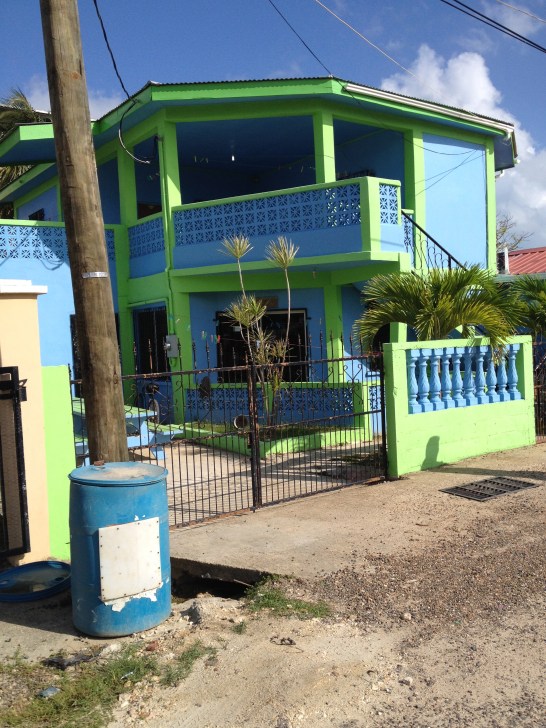
Monday morning, everyone was up and about early and for good reason. We were in a different country so many of us wanted to go out and explore around the neighborhood. After a wonderful breakfast prepared by Caroline, Starfish House’s caretaker, many individuals from our group walked down the street to the nearby beach. Along the way, we saw some of the local wildlife that inhabited the streets. They included large iguanas that were easily the size of cats back home and colonies of crabs that have dug condos for themselves in the ditches of the streets. You see, Belize sits below sea level, so the ground is shallow enough for crabs to dig for damp homes for themselves. This also means that Belize is prone to flooding during the rainy seasons so many of the houses here are placed on tall pillars to prevent constant house flooding. As much as we wanted to explore some more, we had a job to do and I did not want to waste a minute of the day.

IMG_0508IMG_0486

Our first step was to collect wood form the lumberyard and haul it to the worksite. Normally, our project worksites are many miles away in the most remote areas of Belize, but not this time. This week our workplace was only a block away from the Starfish House, which was very fortunate for us. This way we can spend more time doing things and less time traveling to the location.

The worksite was on the property of Ms. Price, a longtime supporter of Pappy and Janet Castillo, the family we were building the house for. Ms. Price had donated a portion of her land so Pappy and Janet can have a safe place to live. At the work site we met the remainder of our crew. Besides our group of 13, there was also Beto and Alfonzo from HHM, who coordinate builds like these, volunteers from the local community, Pappy and Janet of course, and future HHM house recipients.

To complete our task for the week, we had but one power tool at our disposal, a power saw. Aside from the electric saw to cut the wood we need, we had no other power tools for our project. That meant no nail guns, no paint sprayers, and no power drills. Assembling the house was to be done by hand with hand tools and no preassembled parts, a concept that was quite foreign to most Americans. Most of the people in my group were not accustomed to building anything bigger than a birdhouse or using hand tools, including myself. The people of HHM have been in charge of over 200 house building-projects all over Belize, and they have taught newcomers less experienced than us how to saw, hammer, and paint houses just like ours. As such, during the floor assembly, everyone got a chance to practice hammering nails and sawing planks to size.

When our first goal was met, it was time to head back to the Starfish House to relax after a hard day’s work. While walking back home, I couldn’t help but feel proud that I was part of a group responsible for building that floor with our own hands. We were all so happy and proud. Later that evening, we bought some drinks and snacks from a nearby corner store to celebrate our first victory in making a change to a family’s life. Some of us sat down to a game of cards to unwind. Some of us shared stories and sang songs to boost morale. I preferred to sit on a pier on the beach with my new friends to just to bathe in the cool ocean wind, soothing ocean waves and watch the sun sink into the distance.

IMG_0480

While we were partying, a man from the Building for Change (BFC) program, Mr. Panton, stopped by to thank us for participating in this endeavor and to explain exactly how the program works. The main guidelines for the program are as followed:

-BFC and HHM investigates applicants to see if they really need a new home

-Applicants must have some way to pay for the house in a ten-year period

-Applicants must show their dedication by volunteering themselves to build two other HHM houses and their own house

-Applicants that pass investigation are under contract with HHM

-Contract lasts for ten years. After ten years, the homeowners can do whatever they want to the house

-While under contract, applicants are not allowed to add or subtract to the house without HHM permission

-While under contract, applicants are not allowed to rent the home to others and cannot add more people without HHM permission

-HHM does not do maintenance to completed houses. HHM empowers homeowners by teaching them how to build a house

-If any rules have been violated by the homeowner who does not intend to desist, HHM may reclaim the house

Thankfully, there have been very few instances where it has become necessary to reclaim a house.

The next day started out a little differently than yesterday. This morning we took a trip to HHM’s other Belize project: Hand in Hand Ministries Outreach Center. It is a small resource center for children who have been diagnosed with HIV and AIDS. This place teaches the children what HIV/AIDS is and how to prevent it for future generations. The outreach center also provides medicine, food, showers, preschool education and a safe place for the kids to play. When we came to visit, the center was closed for summer break so we got to see what the center looks like in its down period. We didn’t see the children of the center until Wednesday when Resource people invited us for lunch.


After completing the tour of the resource center, we took a detour to visit to Frank Lizama, the wood artist. Mr. Lizama used to be the mayor of Belize City; now he spends his time crafting and selling religious wood masterpieces in his shop. Some of his works can be found in St. Martin Church. The hallmark of his creations is his famous Y Cross. A wooden crucifix made of beautiful Zericote wood with the Son of God stapled to a “Y” shaped cross instead of the traditionally “T” shaped one. The story behind this piece is that whenever Frank looks onto a crucifix he asks, “Jesus, why did you die for us?” The reply in his heart is, “Because I love you.”

We placed our orders for some of Mr. Lizama handiwork, and we were given a chance to take a quick look around his workshop to see what a woodcrafter’s work place looks like and what kind of tools he uses. After the tour, we hastily returned to the worksite to resume our work on the house-building project. With most of the day already burnt out, we had little time to waste if we wanted the home finished on time. Today our daily goal was to build the four main walls and then paint them using oil-based paint.

As soon as we arrived to the workplace, everyone raced to their tools and work stations. I was part of the sawdust team. Our task was to use the power saw to cut the wood parts for the build team to hammer together. The painters would then come in to paint the finished walls.

Though the idea was straightforward enough, my group had never built a house before so we didn’t know what to do after each task was done. As such we spent a majority of the time looking for Mr. Alfonzo to tell us what was next or look around and see what else needed to be done. Thankfully, with everyone’s cooperation, we were able to complete the walls on time. Soon after, we returned home to rest, go for a beer run, and prepare for the next day.

Belize

After touching down and stepping out of our cool, comfortable, air-conditioned plane, the first thing I noticed about Belize is that it is hot. It may have been early afternoon, and it already felt like was hot and humid enough to bake breakfast on a sidewalk. Inside of the airport was not much better. While here, in the United States, we are spoiled enough we keep the inside of our buildings warm or cool according to what we desire, the buildings in Belize only provided shade and shelter. No air-conditioning. Residents of Belize didn’t care about the heat because that’s all they have most of the year. Belize only has two seasons all year round: hot and rainy.

Our bus driver and program coordinator, James, gave our group a tour around Belize City before heading to our boarding house for the week. The moment we started out, I noticed immediate differences between our cities back home and the city here. While in the States, people try to live apart from each other as much as possible. In Belize, it seems like the entire city was stacked on top of each other. All the buildings were meshed together and the entire populace was out and about. The streets were full of vendors selling the fruits of their trade to any passerby. Some sold fresh fish; others, fruit, hot lunches, and other goods. James went on to explain that Belize’s nationality is a mixed population of Maya, European, Spanish, Middle East, Asian, and American. Because of the density of the population and scarceness of resources, the people really don’t care about racial superiority. Nobody in Belize can afford to be picky about their neighbors. They only care about living their lives and will take any help where they can find it. The only real crime in Belize is illegal drug trafficking. Even the customs regarding driving differed between the United States and Belize. The rules weren’t difficult to understand. The main rules were whoever has the biggest car has the right-of-way and pedestrians are to make like a frog in traffic and DODGE!

We stopped by the Starfish House to drop off our luggage. But before we got comfortable at Hand in Hand Ministries’ (HHM) Belizean home, we were taken to the sites of past HHM house-building projects to meet the families who now reside in them. This tour was to give us newcomers an idea what the houses actually look like inside and out and to see how the families best utilize their home. This was also an opportunity for us to meet the kind of people we were helping during our stay.

IMG_0610

After the second house visit, my consciousness began to steadily fade. Like a brick lunched from a second story window. My lack of sleep from the night before had finally caught up with me, and I felt like a dying phone battery. After we said our goodbyes to the families HHM has helped, we set off to the Starfish House, our home for the next seven days.

HHM uses the starfish emblem a lot during their line of work. They use the starfish as something as a mascot in a lot of their functions. The reasoning behind this is because HHM draws inspiration from “The Starfish Story.” The story goes like this:

One day a man was walking along the beach when he noticed a figure in the distance. As he got closer, he realized the figure was that of a child picking something up and gently throwing it into the ocean.

Approaching the child, he asked, “What are you doing?”

The youth replied, “Throwing starfish back into the ocean. The sun is up and the tide is going out. If I don’t throw them back, they’ll die.”

“Dear,” the man said, “don’t you realize there are miles and miles of beach and hundreds of starfish? You can’t make a difference!”

After listening politely, the child bent down, picked up another starfish, and threw it into the surf. Then, smiling at the man, he said, “I made a difference for that one”.

HHM uses this story as their symbol, philosophy, and inspiration towards all of their endeavors. A metaphor I tend to agree with. In the line of social work and even as an individual, one person can’t change the world alone, but one person is enough to change the lives around him.

It was about late afternoon when my group finally returned to the Starfish House and my eyelids couldn’t have been happier. As soon as we crossed the doorway of the Starfish House, everyone soon drowsily migrated to their assigned beds and took a much-need nap before finishing dinner and a lovely mass at the open-air St. Martin’s Catholic Church.

I’m Ready to Go

Beep, beep, beep goes my alarm. As usual doing its daily duty to interrupt my dreams and remind me of my own daily tasks that can’t wait after nine in the morning. But today I needed to wake early, very early. Too early for work, school, or Christmas, although I was just as excited for the occasion. Today was special, for it was the day to make a difference to my life and many others. At 6 o’clock in the morning in the summer of 2014, I left for my immersion trip to Belize in Central America.

The concept of me traveling to another country has been a fond fantasy of mine. Whether it was for business or pleasure, I wanted to see the world in its true colors. On TV, we often hear the best features of a far-off place to attract tourists, and we hear the worst of another to fester panic for a news broadcast. I wanted to go to these places and see these places in their true light. I want to see the world through an unfiltered lens.

I have made attempts to follow this desire many times in the past. My first was in college and I applied to the school’s Study Abroad Program. Unfortunately, I didn’t have enough money to take me through that route. After college I tried again through the Peace Corps. With a social work degree and a sizable volunteer background, I thought I was a shoe-in to travel AND inflict some good in the world. Alas, it was not to be. The national level recruiters thought that I didn’t have the social competence to handle changing circumstance on the job, and so that bridge fell through along with a good portion of my hopes for the future.

Out of desperation, I entertained the idea of joining the Navy. I had no illusion of being the next American super soldier, but given the vocation of the men and women who are on board these ships, they would surely need a psychologist for professional counseling on board while traveling from one port to another. I went to their recruitment office to ask if they had room for a social worker. Only to found out that it didn’t matter. The Navy hiring policy prevented anyone with autism to join under any circumstances. As you might imagine, I was understandably sore to be denied due to something that wasn’t my fault. And so I was stuck in Kentucky and forced to continue working at a job that exercises none of my talents and satisfies none of my desires.

During an average day at work, I was in the middle of my usual routine when a thought hit me, “Hand in Hand Ministries does mission trips right?” With that one question, more sprang up. What is involved in these trips? How much does it cost? What skills are needed? What good can I accomplish? Soon questions became curiosity. Curiosity became ambition. And ambition became a plan.

At once, I shot Hand in Hand Ministries an e-mail asking them about their mission-trip programs.

Ever since my Eagle Project during high school, I have been a frequent volunteer for Hand in Hand Ministries (HHM). Their needs were often domestic, such as unloading a truck of incoming donations, loading outgoing donations to needy communities, and preparing HHM’s newsletter. However, HHM’s yearly hallmark of accomplishments is in their immersion trips to Appalachia, Nicaragua, and Belize. Every year HHM would gather a group of volunteers to venture to these locations, spend several days with the local community, take some time to see the world as they do, and leave behind a change for the people there. Although I knew about of these programs, I was focusing my efforts in joining a Peace Corps-type program and never investigated what was involved in HHM’s overseas programs.

I looked over HHM immersion brochures and became attracted to their Building for Change program in Belize. The trip involved taking a group of about 13 volunteers to Belize City and building a 16-foot-by-16-foot house for a family in one week.

At first the idea sounded preposterous. A group of 13 with no home-building experience is going to build a house in just seven days? However, the manager of the program assured me that:

1) It is not only going to be the 13 of us. We will have additional help from other families and volunteers with homebuilding experience

2) HHM has built over 250 houses just like this all over Belize and has always managed to finish the job in three-to four-day span

3) A 16-by-16-foot house is about the size of a small garage. Plus, our task will not include installing electricity, running water, or outgoing plumbing.

With my doubts quelled I immediately made arrangements to follow this quest.

To make arrangements easier I booked my place on the trip months in advance giving me plenty of time to prepare. Getting the time off work was not a problem. After a year of box shunting, I was due for a trip anyways and was able to request a full week of vacation time off. The trip was expensive, too, but I have been saving my hard-earned money for just such occasion. Getting the supplies was no problem, either; HHM provided me a supply list and a schedule so I would know exactly what was supposed to happen and what I would need for that time. Naturally, my parents would be worried for my safety overseas, but they were proud to see me go out into the world and do some good like they had in their youth. With preparations set, I was ready to go and fulfill my ambitions at last.